At the heart of Nuyumbalees is a collection connected to family, ceremony and the continuing life of the community.
MORE THAN A COLLECTION
Connections that endure.
Ceremonial belongings carry relationships with people, histories and cultural responsibilities. Their return is the story that brought Nuyumbalees into being.
The potlatch marks important occasions and holds a central place in the social and ceremonial life of coastal First Nations. Canada’s prohibition of the potlatch, introduced in 1884, sought to suppress this way of life.
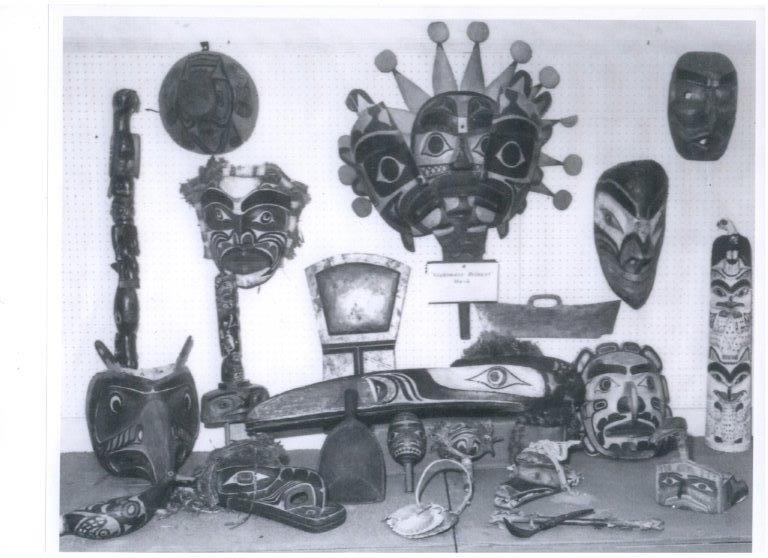
Following a large potlatch on Village Island in 1921, people were arrested and ceremonial belongings confiscated. Many belongings entered museums and private collections far from their communities.
Historical photograph from the Centre’s published account of the Potlatch Collection.
DECADES OF DETERMINATION
The work of bringing belongings home.
The potlatch ban ended in 1951. The work of repatriation continued.
Chiefs, Elders and families worked to recover ceremonial belongings and reconnect them with their communities. In 1975, Hereditary and Elected Chiefs founded the Nuyumbalees Society to negotiate the return of the collection and regalia.
The fifteen founding Chiefs chose Cape Mudge as the site for a new facility. In February 1979, 104 belongings returned. The Cultural Centre opened that June.
The collection is part of a living cultural context. Its significance lies in these continuing relationships, as well as in the history of its journey.
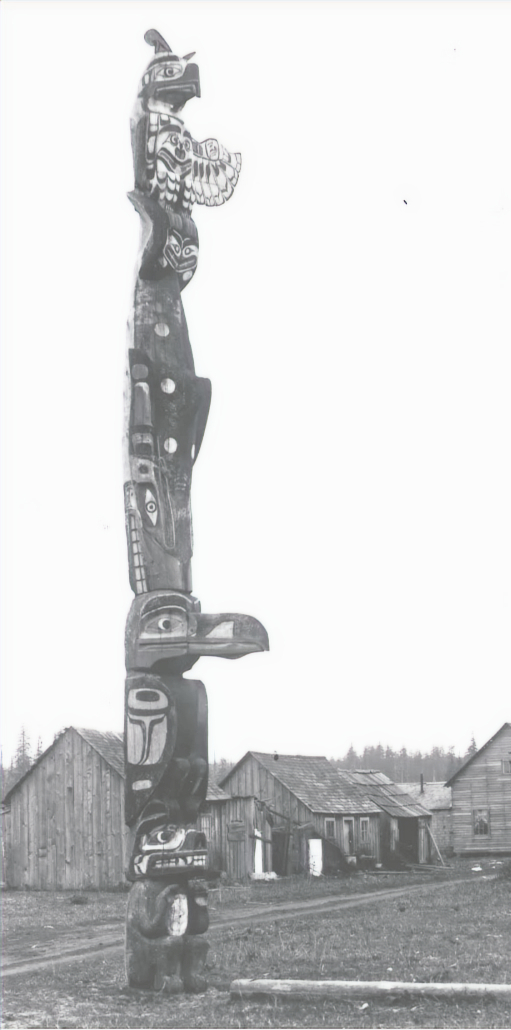
The Centre’s published account identifies this pole as the work of Chief Johnny Klakwatsi of Salmon River. It belonged to Chief Billy Assu, who gifted it to the Quocksister family of Campbell River on the occasion of his daughter Susan’s marriage.
It was later sold to the Calgary Zoo in the early 1900s. In 1983, it was repatriated to Nuyumbalees.
This individual story sits within the wider history of belongings taken far from home and the work of bringing them back.
A visit to Nuyumbalees is an opportunity to learn the history of the collection within the setting of the community. Please follow staff guidance around ceremonial belongings, displays and photography.
If you are arranging a school or group visit, contact the Centre ahead of time to discuss your interests and the arrangements available.